Sustainability Hub in Vauban, Freiburg, Germany
In the 2007-2008 school year, we studied abroad in Freiburg, Germany, and lived in the Vauban neighborhood. This old French military barracks had been recently converted into a thriving sustainable community with energy efficient buildings, excellent transportation options (more than 70% of trips are non-car), and a balanced mix use of buildings that made a thriving community. We lived in part of the old French military buildings, and around us many new multifamily buildings with schools, bakeries, offices, and shops had been built. Going to Freiburg, we were already into sustainability concepts, but after seeing them here in practice, we fully jumped on the bandwagon.
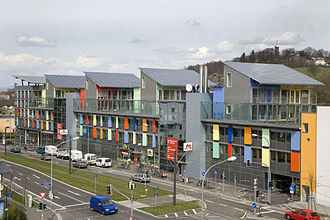
SolarShipThe SolarShip is an mixed use retail, office, and residential building along the main road that goes through the neighborhood. The "plus energy" building generates more energy than it consumes.
|
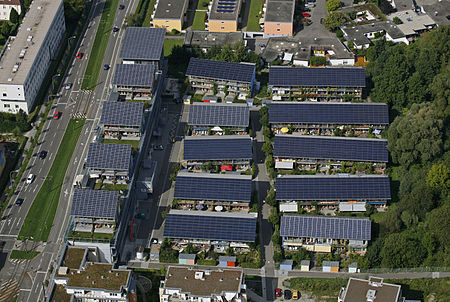
Solar SettlementIn this picture, the Solar Ship is located on the left and the "Solar Settlement" is the group of ~10 multifamily buildings covered in solar PV on the right.
|

Holistic Approach to SustainablityVauban was just a pleasant place to live. Our door was located ~150 feet from this public square in front of the school, which housed a weekly farmers market.
|
S-House in Boehmheimkirchen, Austria
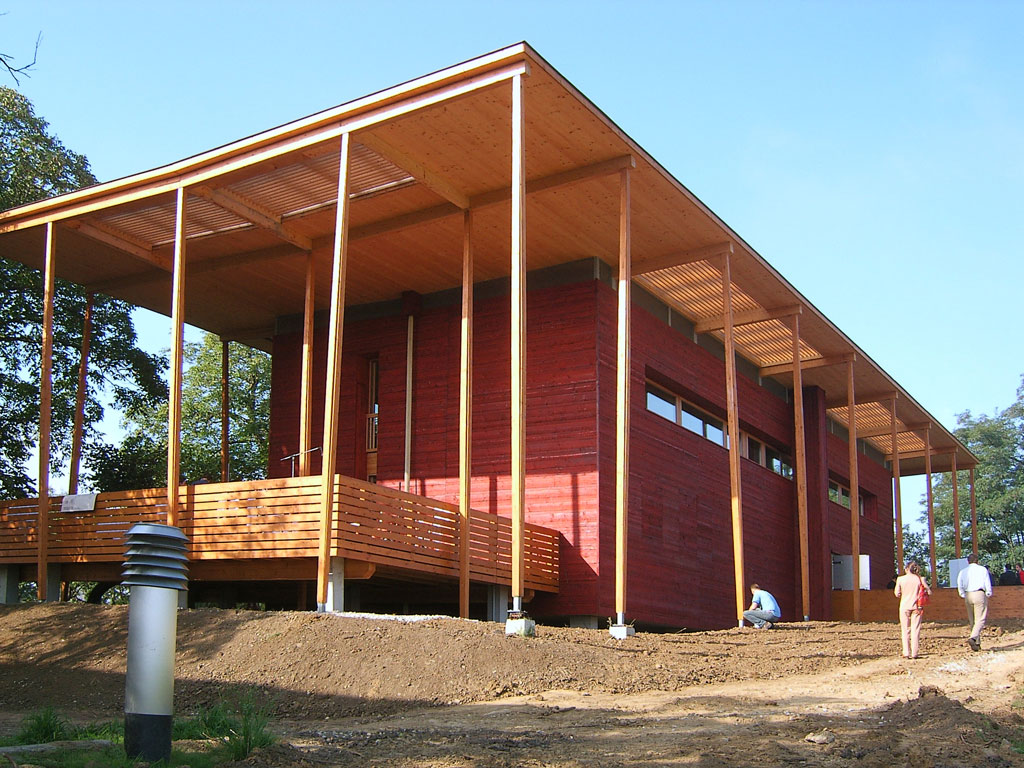
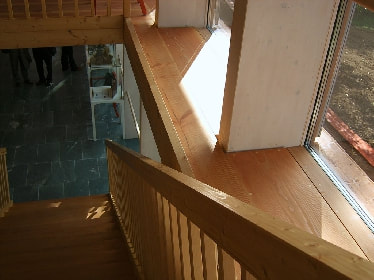
While living in Austria from 2011-2013 and teaching at an agricultural high school, Katie attended a field trip with her students to the S-House, led by Hannes Hohensinner, a teacher at the school and build team member of the S-House. This one-of-a-kind office building was constructed by the Center for Appropriate Technology at the Technical University of Vienna in 2005 and showcases a 90% reduction in the consumption of resources in construction as compared to typical construction, with the majority of materials being raw, natural materials.
|
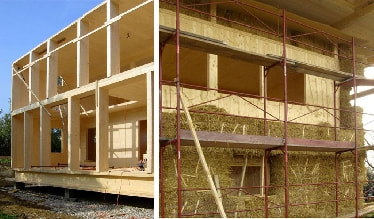
The S-House is located in a mild climate near Vienna, Austria; thus the design challenges regarding temperature and moisture are less than on our build. Here, the building was built off the ground with bales under the floor, in the walls, and in the ceiling.
|
The building is also a passive house, designed to maximize passive solar energy. The overhangs limit unwanted heat gain and glare, while the red facade is actually a furred out rain screen.
|
Though functionally it is an office building, the S-House also serves as a demonstration center. Here we see the enormously thick walls from the strawbales. Besides the windows and doors, the building is made entirely out of natural materials - wood, straw, plaster, and bioplastic screws. Not even metal nails were used!
|
Construction Sites in Munster, Germany and Sankt Florian, Austria
Through her work as part of the Minnesota delegation with the Climate Smart Municipalities program, Katie toured a construction site for a multifamily building in Munster, Germany in 2019. She extended her trip to Austria to visit friends and come upon a single family home construction site in a small town outside of Linz. The main takeaways from these visits were the value of durable exteriors, the validity of rockwool as an insulating material (which will be used on our Triplex), and the viability of plaster as a preferred interior covering.
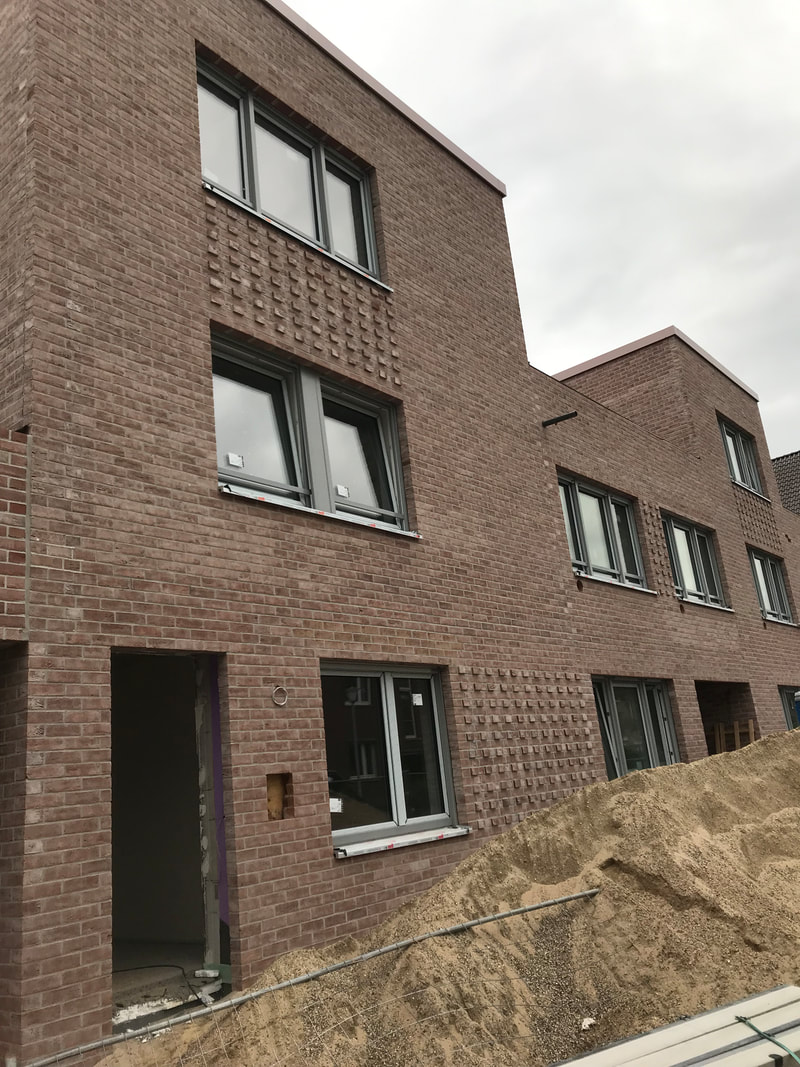
Durable ExteriorsThe multifamily building being developed by the City of Munster's housing authority is built with durability in mind with simple, brick facades and high-quality tilt-turn windows.
|
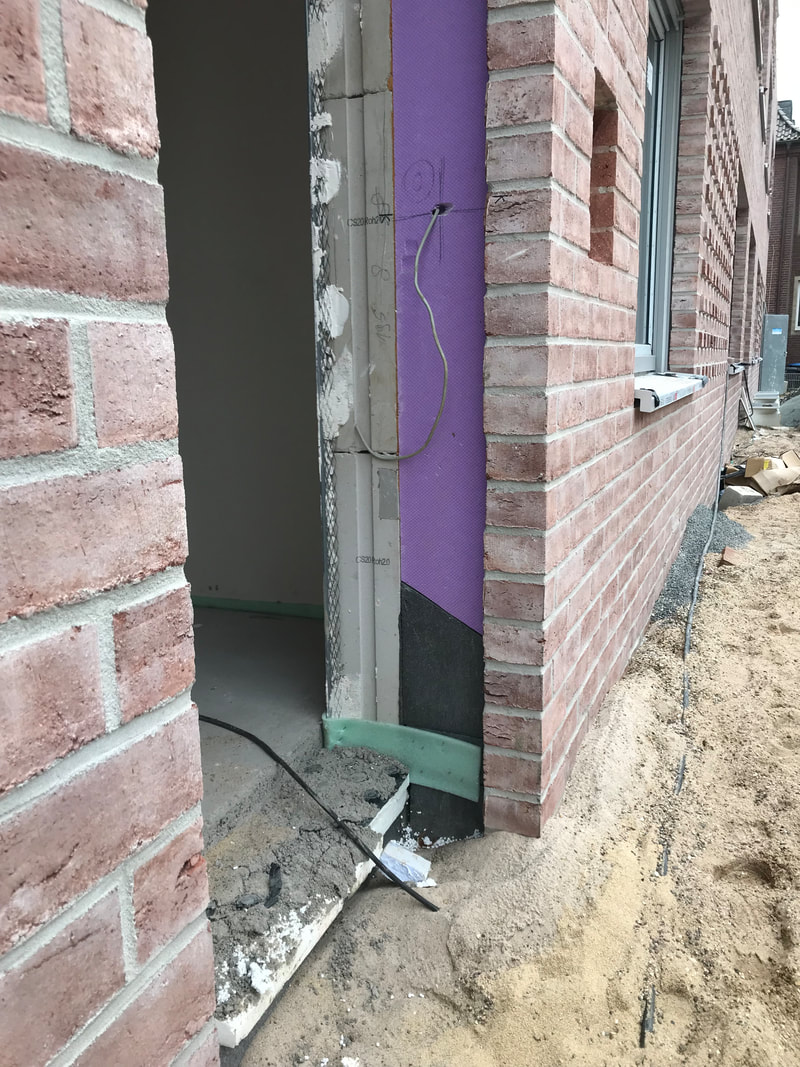
Insulated InteriorsA profile view of the walls shows from exterior to interior: the brick facade, 7.5 inches of rockwool insulation (in purple, total R value =~22), concrete block structure, and plaster walls. Plaster walls are standard in European builds.
|
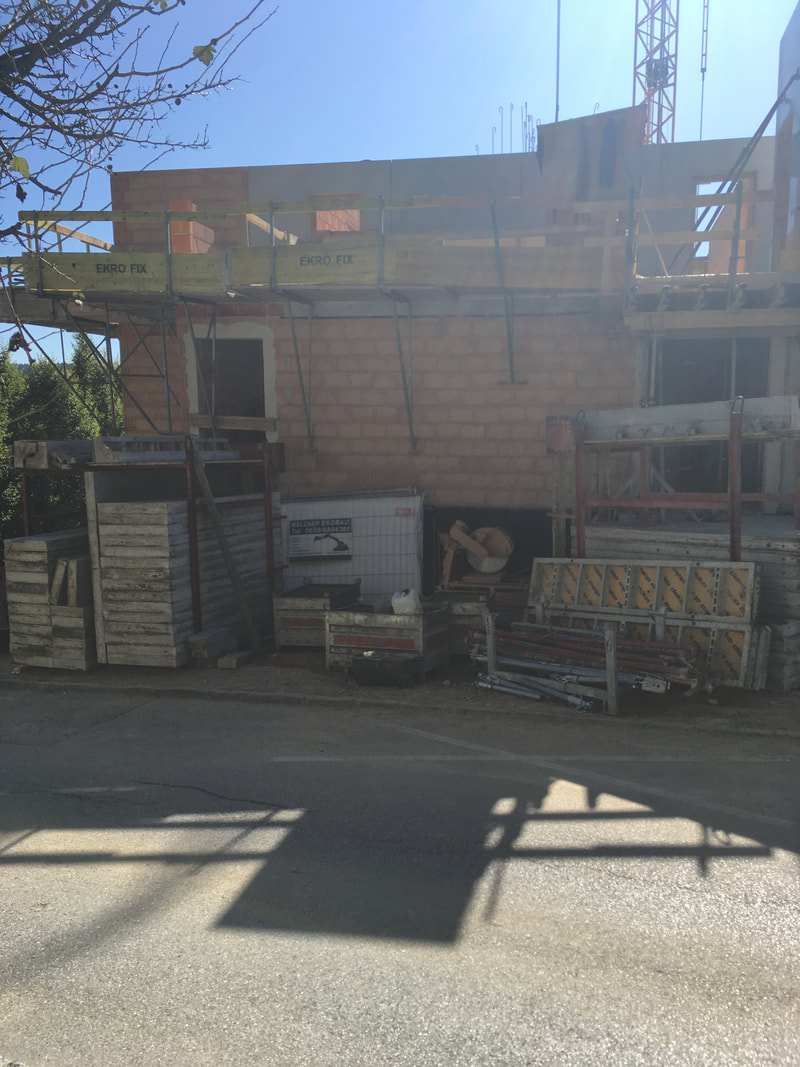
Bricks, Bricks, EverywhereWhereas 2x4 construction is standard in the US, these orange bricks are the standard structural member for low rise buildings. The bricks have intricate chambers/pockets that act as better insulators than standard bricks. However, in talking with Prof. Hohensinner he said Europeans have not fully come to terms with the added carbon intensity of creating such bricks.
|
